



 DayZ
DayZ Palworld


 Enshrouded










Rust Server Hosting Canada
Rent Your Rust Dedicated Server, Ready for Wipe Day
About Rust server hosting
Premium Rust server hosting from GTX Gaming's Canadian and worldwide datacentres. Rent a Rust server with one-click Oxide (uMod) and Carbon installs, a built-in browser with over 1500 uMod plugins, custom maps, wipe tools for forced wipe day, Rust+ app support, instant setup, plans with the 12GB of RAM Facepunch asks for, up to 100GB of NVMe storage, automatic backups, enterprise DDoS protection and 24/7 support in 18 locations. Rent your Rust dedicated server from CA$17.77/mo.
Rust Server Hosting: Plans & Pricing
- Instant setup
- 12GB RAM
- Up to 100GB NVMe storage
- One-click Oxide & Carbon
- 24/7 support
- 16GB RAM
- Up to 100GB NVMe storage
- Plugin browser
- Custom maps
- Automatic backups
- 20GB RAM
- High CPU Priority
- 160 players
- Up to 100GB NVMe storage
- 50 to 1000 slots
- 10GB included, up to 32GB
- CPU priority & clock boost
- Storage up to 200GB
- 24/7 support
- DDoS protection
- Instant setup
One Rust server, priced by slots and memory. Our ready-made plans pair each slot count with at least the 12GB of RAM that Facepunch's server guide asks for, every server includes up to 100GB of NVMe storage and DDoS protection, and you can change your plan at any time without losing your map.
The Rust Server Hosting Control Panel
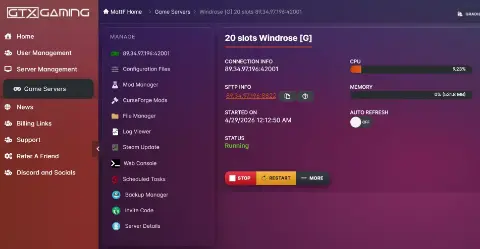
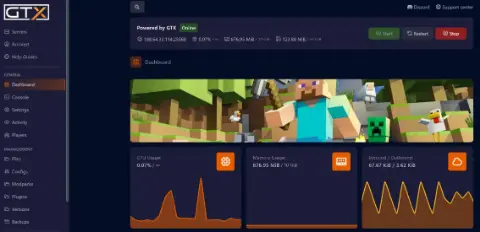
Our custom panel puts your Rust server's settings, plugins, map, wipes, updates and backups in a browser, so you spend wipe day playing instead of editing files over remote desktop.
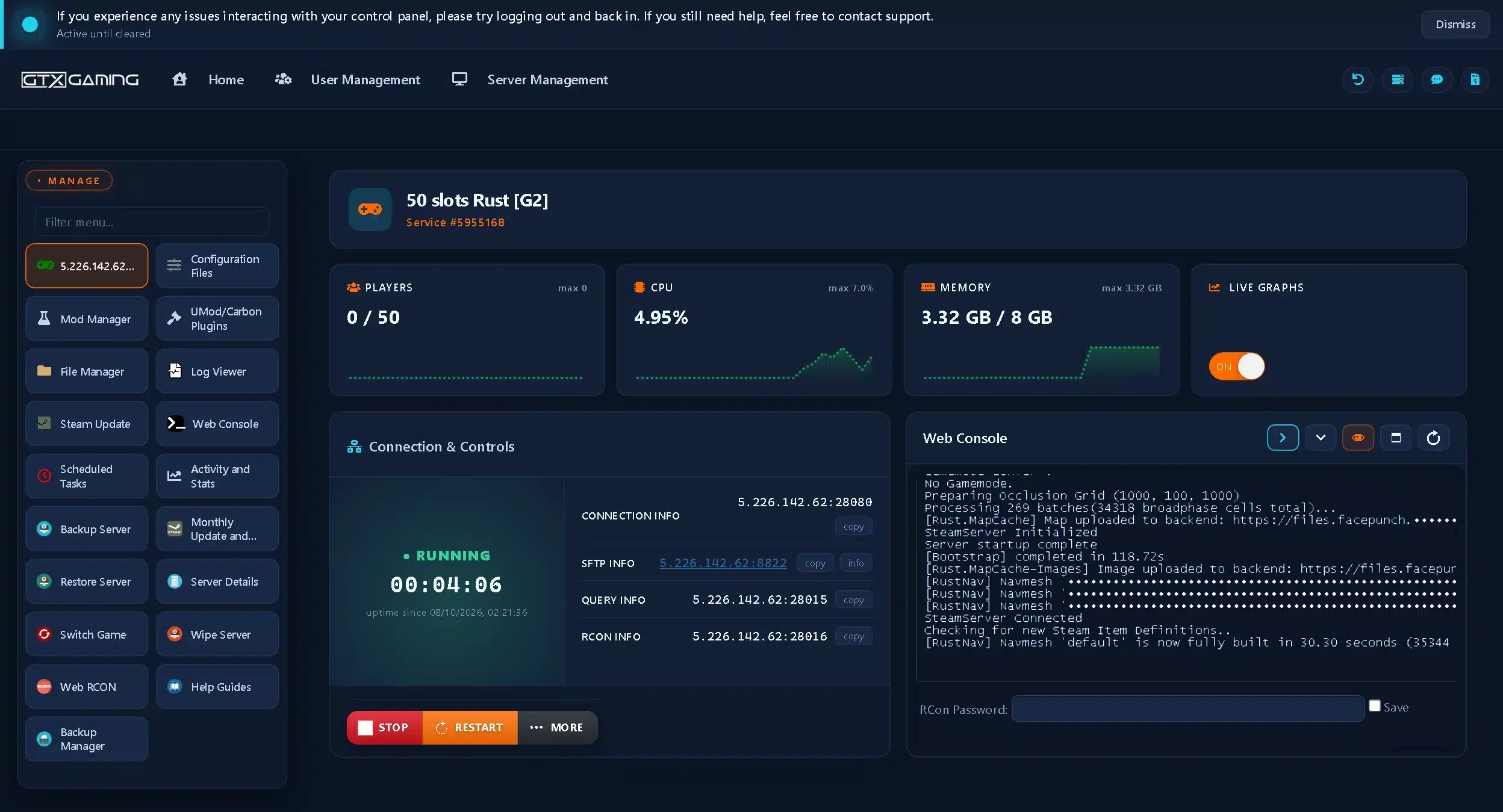
- 🎛️One-click controlsStart and stop your server, copy its connection, query and RCON details, find your SFTP details, and watch players, CPU and memory on Live Graphs.
- 🧩Mod ManagerInstall Carbon or uMod (Oxide) in one click, plus the Discord and Rust Edit extensions and a MySQL Database with phpMyAdmin.
- 🔌UMod/Carbon PluginsA built-in browser with over 1500 uMod plugins: search, sort and install each one with a single click.
- 🧨Wipe day toolsMonthly Update and Wipe and Wipe Server for wipe day, and Scheduled Tasks for automatic restarts, updates and backups.
- ⚙️Configuration Filesserver.cfg for your name, description, banner and map, users.cfg for owners and moderators, bans.cfg and Start.bat.
- 💾Backups, Web Console & Web RCONBackup Server, Restore Server and the Backup Manager, plus the Web Console, Web RCON and Log Viewer in your browser.
Rust Server Hosting: Oxide, Carbon & Plugins
Run Rust exactly as Facepunch made it, or turn your server into anything from a 2x server with kits to a PvE community. Nothing is preinstalled, so your server stays vanilla until you choose; then the Mod Manager installs Carbon or uMod (Oxide) in one click and the built-in plugin browser adds uMod plugins.
A self-updating, drop-in replacement for Oxide that runs most Oxide plugins. Install it from the Mod Manager in one click, with a staging branch for testing.
Plugin FrameworkThe long-running Rust plugin framework, one click from the Mod Manager, with staging branches for testing. It must be updated after every Rust update.
Plugin FrameworkUMod/Carbon Plugins lists over 1500 uMod plugins inside your panel, with search, sort and a one-click Install button for each.
1500+ PluginsThe Rust Edit extension makes your server compatible with RustEdit custom maps. It needs Oxide or Carbon.
MapsAdd Discord support for your plugins in one click, in a Carbon or a uMod version.
ExtensionSome uMod plugins need a MySQL Database: install one from the Mod Manager, and phpMyAdmin to manage it.
DatabaseAlready running Rust at home or with another host? Upload your server identity folder, with your map save, blueprints and plugin folders, through the File Manager or SFTP and carry on where you left off. Our 24/7 team can help with the move.
How Many Slots Does My Rust Server Need?
Pick a slot for every player who will be online at the same time on your busiest night, usually wipe day. Prices below include 12GB of RAM, the figure Facepunch's server guide asks for.
| Slots | Best for | With 12GB RAM |
|---|---|---|
| 50 slots | A clan or a small community | CA$30.05/mo |
| 100 slotsRecommended | Active community servers | CA$46.74/mo |
| 160 slots | Popular community servers | CA$65.33/mo |
| 200 slots | Large public servers | CA$76.93/mo |
| 300 slots | Big wipe-day crowds | CA$103.28/mo |
| 500 slots | Very large public servers | CA$145.71/mo |
Facepunch's server guide asks for 12GB of free RAM, and more for a 6k map, and says the figures highly depend on how the server is used and how many players it has. Bigger maps, more players and plugin packs need more memory: choose from 14GB up to 32GB at checkout or at any time from your client area. On our own 50 slot demo server, a fresh default map used about 3.3GB of memory after startup, with nobody online. Every server includes 10GB of RAM, which suits a small, low-population vanilla server on a smaller map.
Rust Server Hosting Locations: Low Ping Canada & Worldwide
Rust servers deploy in 18 locations: Quebec in Canada; New York, Ashburn, Chicago, Dallas, Miami, Los Angeles and Portland in the USA; London, Paris, Frankfurt, Amsterdam and Stockholm in Europe; Sydney, Tokyo, Singapore and Mumbai in Asia-Pacific; plus Moscow. Run a quick test to see your latency to our network.
What's Included With Your Rust Server Hosting?
Every server ships fully loaded. Upgrade any part of it whenever you like.
| Resource | Included | Optional upgrade |
|---|---|---|
| Player slots | 50 to 1000 slots, chosen at checkout | Change your slot count any time |
| Memory | 10GB of RAM on every server; plans with 12GB to 20GB | Tiers up to 32GB, changed any time |
| Storage | Up to 100GB NVMe free | Tiers up to 200GB, plus extreme 14,000MB/s NVMe |
| Plugins | Carbon or uMod (Oxide), plus a browser with over 1500 uMod plugins | Installed in one click when you want them |
| Wipes | Monthly Update and Wipe and Wipe Server tools | Scheduled Tasks for restarts, updates and backups |
| CPU priority | Normal priority on high-frequency cores | High and Realtime tiers |
| CPU clock | Standard high-frequency clocks | +5%, +10% and +20% clock boost tiers |
| Protection | Enterprise DDoS mitigation | Included on every server |
| Backups | Automatic backups, Backup Server and Restore Server | Daily off-site backups, kept for 6 months |
Slots, RAM, storage, CPU priority and clock boosts are all picked at checkout and can be changed later without losing your map. Every player needs their own copy of Rust on PC (Steam) to join.
Rust Server Hosting Features: Everything Built In
Every server ships with the full GTX feature set, no hidden add-ons.
Rust Server Hosting: the essentials
GTX Gaming Server Hosting Reviews
Verified Trustpilot reviews from GTX Gaming customers.
A+ Rust Host!
I have a modded Rust server through GTX gaming, and I would have to say it is the best gaming host I have dealt with ever. Easy to use control panel, never had downtime in the months I have used them, and the 2 times that I have had to contact customer support (which was server setup and another issue), they were extremely professional and replied as soon as possible. The control panel is easier to use than LogicControl and is your server and if you choose to upgrade its really easy to do so, since Rust is a CPU hog. If I ever need another server, GTX will sincerely be my 1st choice.
I've used GTX Gaming for over a year
I have used GTX Gaming for over a year now, they host my Rust server. I have nothing but praise for these guys, they all ways respond quickly to my support tickets as and when I need to use them. I did have 1 problem, which was quickly addressed by moving me to a new rig and server, with better equipment, and all for the same price I was all ready paying. I will continue to use GTX for as long as i need a Rust server.
I've run RUST servers on multiple...
I've run RUST servers on multiple server providers (obviously not gonna mention their names) and some have been good, some have been catastrophic. But in terms of server stability, customer support and just easy to use nothing beats GTXgaming. Just really happy, haven't needed to contact them for any problems, only contacted them when I wanted to upgrade my server capacity and got a reply within 10 minutes and provided me with all info etc. 5/5 thanks a lot!
Rust Server Hosting FAQ
How fast is Rust server setup?
+What is Rust server hosting?
+How do I join my Rust server?
+Are your Rust servers for PC or console?
+Can I move my existing Rust server to GTX Gaming?
+Do you support Oxide (uMod) and Carbon?
+Can I wipe my Rust server and change the map seed?
+Can I use a custom map on my Rust server?
+Will plugins move my Rust server to the Modded tab?
+Does my Rust server work with the Rust+ app?
+How many players can join my Rust server?
+How much RAM does a Rust server need?
+Which locations can I host a Rust server in?
+How much does Rust server hosting cost in Canada?
+What is your refund policy?
+Do you offer monthly Rust server hosting with no contract?
+The Complete Guide to Rust Server Hosting in Canada & Worldwide
Everything you need to know before you rent a Rust server in Canada or any of GTX Gaming's worldwide locations, from joining and wipe day to map seeds, custom maps, Oxide and Carbon plugins, Rust+, backups, slots, RAM, pricing and locations.
What Is Rust Server Hosting?
Rust server hosting is a managed service that runs a Rust dedicated server on professional hardware in a datacentre, around the clock, so your community can farm, build and raid on the same map until wipe day, whether or not you are online. Every GTX Gaming Rust server includes up to 100GB of NVMe storage, automatic backups, enterprise DDoS protection and a web control panel, and our ready-made plans pair each slot count with at least 12GB of RAM, so jobs like installing plugins, wiping the map or loading a custom map take a few clicks instead of an evening of config files.
People search for it as a Rust dedicated server, a Rust game server, Rust server rental or simply a Rust server to rent, and they all mean the same thing: an always-on Rust server with your map, your plugins and your rules.
What Is Rust?
Rust is the multiplayer survival game from Facepunch Studios, who develop and publish it: gather resources, craft, build a base and defend it from other players, or raid theirs. It was fully released on 8 February 2018, and Facepunch has shipped a content update every month since, with more than a million Steam user reviews along the way.
- Survival meets PvP: every base can be raided, so clans, alliances and grudges shape each wipe.
- Procedural or custom maps: every wipe can bring a new procedurally generated map, or a map built by the community.
- Monthly updates: the latest when we wrote this in October 2026 was the Livestock Update of 1 October 2026, which added cows and sheep, a livestock economy at the Stables and the Biofuel Generator.
Why Rent a Rust Server?
Facepunch makes the Rust dedicated server free, so you could run it on a spare machine at home. Most communities rent a Rust server instead:
- Always online: bases, upkeep and decay keep running 24 hours a day, and your players expect the server to be up whenever they log in.
- Enough memory: Facepunch's server guide asks for 12GB of free RAM, more for a 6k map, on top of whatever else the machine is doing.
- Nothing to run at home: no ports to forward on your router, no PC left on overnight, and no home connection exposed to attacks.
- Backups and support: automatic backups and a 24/7 support team mean a broken plugin or a bad wipe is an inconvenience, not the end of your server.
How to Set Up & Join Your Rust Server
Your server is set up the moment you order. From there, getting your community onto the map typically looks like this:
- Order: choose your plan and your location, and your server is ready within seconds.
- Name it: set the server name (server.hostname), description and banner in server.cfg under Configuration Files: the name your players see in the server browser.
- Make yourself admin: add your SteamID64 as an owner in users.cfg, as our guide to becoming admin on your Rust server shows.
- Join: start Rust, press F1 to open the console, type connect [IP]:[port] and press Enter, or find your server in the in-game server browser.
Rust's default game port is UDP 28015, but your server may use a different one, so always copy the full address from your control panel. A server appears in the browser once its query port is reachable, under Community or Modded depending on your plugins. These servers are for Rust on PC (Steam). Rust Console Edition is a separate game, developed and published by Double Eleven for PlayStation 5 and Xbox Series X|S, with its own servers and its own wipe schedule.
Rust Wipe Day: Forced Wipes, Blueprints & Schedules
Wipe day is the heartbeat of Rust. Facepunch releases its monthly update on the first Thursday of the month, and that update forces a map wipe on every server. The server's built-in wipe timer follows the same rhythm: by default it counts down to the first Thursday of each month at 19:00 London time, and it can also be set to weekly or biweekly.
- Forced wipe: resets the map. Blueprints survive unless you also delete the player.blueprints file, which many servers do once a month for a full wipe.
- Your own wipes: many communities add weekly or biweekly map wipes between forced wipes, to keep the map fresh.
- Tell your players: add the wipe schedule to your server tags (monthly, biweekly or weekly), so players can see it in the server browser.
Your control panel has Monthly Update and Wipe and Wipe Server tools for wipe day, and Scheduled Tasks for automatic restarts, updates and backups. Our knowledgebase guide to updating and wiping your server with a seed change on forced wipe day walks you through it.
Map Seeds, World Size & Custom Maps
Most servers run a procedural map, built from two settings: the seed (server.seed, any number from 0 to 2147483647) and the world size (server.worldsize, from 1000 to 6000). The same seed and size always give the same map, so changing the seed at wipe time rolls a brand new one. Facepunch's guide notes that the larger the map, the more disk space and memory you need.
Custom maps, built by the community, load from a direct download link: upload the .map file to a public host that is online 24/7, set server.levelurl to its link and remove the seed and world size settings. New players download the map from that link when they join, so it must stay online. Maps made with RustEdit also need the Rust Edit extension, installed from the Mod Manager on top of Oxide or Carbon. Our guide covers adding a custom map to your Rust server.
Oxide (uMod) vs Carbon: Which Plugin Framework?
Plugins turn a vanilla server into anything from a 2x server with kits to a full PvE community. Rust has two plugin frameworks, and a server runs one of them at a time:
- Oxide (uMod): the long-running community modding framework, now distributed through uMod. Facepunch's own guide notes that after every Rust server update, Oxide must be updated too. See installing and configuring Oxide plugins.
- Carbon: a drop-in replacement for Oxide, built so that most Oxide plugins work in it. It updates itself, keeps permissions in SQL and has an in-game interface to install, update and configure plugins.
Oxide and Carbon cannot run on the same server at once. Switching from Oxide to Carbon is straightforward, as Carbon keeps the same folder and plugin structure, but test your plugins after the move. Nothing is preinstalled: the Mod Manager installs Carbon or uMod (Oxide) in one click, with staging branches for testing, and UMod/Carbon Plugins is a built-in browser with over 1500 uMod plugins, each with a one-click Install button. The Mod Manager also adds the Discord and Rust Edit extensions and a MySQL Database with phpMyAdmin for plugins that need one. Permissions for Oxide plugins are explained in configuring plugin permissions, and gather rates in setting custom gather rates.
Community or Modded: How Plugins Affect Your Listing
Facepunch's guidelines decide which tab of the server browser your server appears in. A server with plugins should be listed under Modded, but some plugins are fine under Community: admin plugins that do not change gameplay, skip-queue and chat colour plugins, custom maps, and changes to vanilla convars such as team size or decay. Plugins that change gameplay, such as gather rates, kits or item spawns, and any plugin that creates or changes UI, belong under Modded. Your server must never call itself official, as official servers are the ones Facepunch runs. Our guide to adjusting decay shows one of those vanilla convars.
Server Browser Tags, Name & Header Image
Set server.tags to describe your server: the browser shows up to four tags, such as your wipe schedule (monthly, biweekly or weekly), the difficulty (vanilla, hardcore or softcore), your region, and styles like PvE or roleplay. The Modded, Oxide and Carbon tags are added automatically. Add a header image and a 256x256 server icon (server.logoimage), which also shows in Rust+. See adding server tags and adding a header image.
The Rust+ Companion App on Your Server
Rust+ is Facepunch's official companion app for iOS and Android. Once players pair it with your server, they can check their base, chat with their team, follow the map with teammates, vending machines and live events, and control Smart Switches and Smart Alarms from their phone. The server needs its companion port, by default 28082 (the game port plus 67), to be reachable, and it switches Rust+ off by itself if its connectivity test fails. Our guide covers using the Rust+ app on your server.
Backups, Updates, Restarts & RCON
A good routine keeps your map and your community safe:
- Backups: scheduled backups run for you, Backup Server and Restore Server take and restore a backup when you want one, and the Backup Manager keeps them. Off-site backups are taken daily and kept for 6 months.
- Updates: Steam Update installs the newest Rust server version, and Oxide must follow every server update; see updating Rust and Oxide.
- Scheduled Tasks: automatic restarts, updates and backups on a timer, with warning messages for your players as shown in automatic restarts with warning messages.
- Web Console and Web RCON: run server commands from your browser without being in the game, explained in using RCON and WebRCON, and follow the Log Viewer and the Live Graphs.
How Much Does Rust Server Hosting Cost in Canada?
Pricing is simple: you choose your slots and your memory, with up to 100GB of NVMe storage included on every server:
- 50 slots and 10GB: from CA$17.77/mo. A small, low-population vanilla server on a smaller map.
- Survivor, 50 slots and 12GB: CA$30.05/mo. A clan server or a small community.
- Raider, 100 slots and 16GB: CA$53.85/mo. Active communities and plugin packs.
- Warlord, 160 slots, 20GB and High CPU Priority: CA$88.44/mo. Busy public servers and wipe-day peaks.
- 200 slots and 12GB: CA$76.93/mo. Large public servers, with more memory at checkout.
Every slot tier from 50 to 500 is in the full plan list at the top of this page, and you can build your own mix at checkout, up to 1000 slots and 32GB of RAM. All plans include instant setup, DDoS protection, automatic backups and 24/7 support, with no setup fee and no contract. Billing is monthly by default, with three-month, six-month and yearly cycles at 5%, 10% and 15% off, and you can change plan or cancel at any time.
How Many Slots & How Much RAM Does a Rust Server Need?
Choose a slot for every player who will be online at the same time on your busiest night, which is usually wipe day. Facepunch's guide names no fixed player limit, but notes that the more players a server has, the faster its CPU needs to be, which is why Warlord includes High CPU Priority. For memory, the guide asks for 12GB of free RAM, and more for a 6k map, and says the figures highly depend on how the server is used and how many players it has. On our own 50 slot demo server, a fresh default map used about 3.3GB of memory after startup, with nobody online. So our ready-made plans start at 12GB: Survivor has 12GB, Raider 16GB and Warlord 20GB. The included 10GB suits a small, low-population vanilla server on a smaller map; bigger maps, more players and plugin packs need more, up to 32GB, and you can change your RAM at any time.
Locations for Rust Server Hosting
Raids, roof camping and monument fights are no fun with lag, so host close to your players. GTX Gaming runs Rust server hosting from a Canadian datacentre in Quebec plus 17 more locations worldwide: New York, Ashburn, Chicago, Dallas, Miami, Los Angeles and Portland in the USA; London, Paris, Frankfurt, Amsterdam and Stockholm in Europe; Sydney, Tokyo, Singapore and Mumbai in Asia-Pacific; plus Moscow. Some locations carry a surcharge, shown at checkout. Use the live ping test above to find the lowest-latency location for your players, pick it at checkout, and if you need to move later our support team can migrate your server.
Rust Server Hosting Glossary
Quick definitions of the terms you'll meet across Rust, our control panel and the Rust dedicated server:
- Dedicated Server
- A server that runs your map by itself, around the clock, without a player hosting it from their own PC.
- Wipe
- Resetting the server. A map wipe resets the world and bases; a blueprint wipe also resets every player's learned blueprints.
- Forced Wipe
- The map wipe that comes with Facepunch's monthly update on the first Thursday of the month.
- Blueprint
- A learned crafting recipe. Blueprints survive a map wipe unless player.blueprints is deleted too.
- Seed
- The number that generates a procedural map. The same seed and world size always give the same map.
- World Size
- The size of a procedural map, from 1000 to 6000. Larger maps need more memory and disk space.
- Oxide (uMod)
- The long-running Rust plugin framework, distributed through uMod. It must be updated after every Rust update.
- Carbon
- A self-updating, drop-in replacement for Oxide that runs most Oxide plugins.
- Server Tags
- Short labels in the server browser, such as wipe schedule, difficulty and region. Up to four are shown.
- Rust+
- Facepunch's official companion app for iOS and Android: base status, team chat, map and smart devices.
- RCON
- Remote console access for running server commands without being in the game.
- SteamID64
- A player's unique Steam account number, used to make admins and to ban players.
- SFTP
- Secure file transfer for moving maps, plugins and save files between your PC and your server.
Setup Guides & Help for Your Rust Server
Once your Rust server is live, our knowledgebase covers the common tasks:
- Wiping with a seed change on forced wipe day
- Installing Oxide plugins
- Adding a custom map
- Becoming admin
- Upgrading or downgrading your player slots
- All Rust help guides
Our 24/7 support team is on live chat and tickets for anything the guides don't cover:
Explore Other Services
Host more of your favourites with the same instant setup and 24/7 support.
Last Updated: 8 October 2026